
No Litchfield County Mugshot Roster
No county sheriff mugshot roster was found for Litchfield County. The reason is structural. Connecticut folded its county jails and state prisons into one agency in 1968. The Connecticut Department of Correction, known as CT DOC, now runs all adult custody statewide. There is no county sheriff who books people into a county jail here. That means there is no county booking report, no daily county arrest log, and no county photo gallery to browse.
Searches for a "Litchfield County Jail roster" still happen often. Part of that is history. A Litchfield State Jail did operate from 1812 to 1993, and its name lingers in old records and local memory. The building closed long ago. It is not a place to look anyone up today. The honest answer is plain. There is no active Litchfield County sheriff jail roster, so custody is searched through CT DOC instead.
Most people held after a Litchfield County arrest pass through New Haven Correctional Center. CT DOC names it as the facility serving the superior courts in Bantam and Litchfield. It is state run, not county run, and it holds mainly pretrial detainees. It does not publish a county-style booking page either.
Note: A booking photo and a custody record are not the same thing, and in Connecticut they are kept by different offices that each follow their own release rules.
CT DOC Search Is Not a Photo Gallery
The CT DOC Inmate Information Search is the official tool for current custody. It tells you whether a person is held and at which facility. It is a status locator, not a mugshot gallery. The CT DOC inmate information page explains what the database covers and what it leaves out.
One point matters for tone and accuracy. During research, the locator and a sample profile could not be inspected directly because automated requests were blocked. So no claim can be made that a DOC profile shows a booking photo. CT DOC does not promise booking-photo publication anywhere on its public page. Treat the locator as a way to confirm where someone is, not as a guaranteed source for a picture.
The database also has limits worth knowing. CT DOC says it updates the data daily, yet status can change fast and the site may lag. Current custody does not mean a conviction, because people awaiting trial are held too. Two groups are left out entirely. Youthful Offender Statute cases and people held for federal immigration authorities do not appear in the DOC search. For current custody and booking photos, the live roster on the Litchfield County jail inmate records page walks through the same CT DOC lookup in more depth.
Connecticut FOIA and Arrest Records
Whether a booking photo is public comes down to Connecticut's records law. The state Freedom of Information Act, known as FOIA, makes records held by public agencies open to inspection unless an exemption applies. FOIA is the legal route that can reach a booking photo that is not posted online. It does not put every photo on the internet, and it does not override the law's exemptions.
The FOIA chapter has a law-enforcement provision that bears directly on booking photos. It says a public record that documents or depicts the arrest or custody of a person during a pending prosecution shall be disclosed, subject to the exemptions in the act. That supports access to certain arrest and custody records, including some booking images. Several limits can still block release. Erased records, youthful-offender cases, juvenile matters, open investigations, victim privacy, and safety concerns can each keep a record from being handed over.
Because there is no county sheriff here, the request does not go to a county jail. It goes to the agency that made the arrest. That is usually the Connecticut State Police or a town police department.
Key Statutes
Conn. Gen. Stat. Sec. 1-210 sets Connecticut's core rule that public-agency records are open for inspection and copying unless a statute or an exemption says otherwise.
Conn. Gen. Stat. Sec. 54-142a erases eligible criminal records after dismissals, acquittals, qualifying nolles, and pardons, which can pull a related record out of public reach.
How to Request a Litchfield County Booking Photo
A booking photo is requested through official records channels, not bought from a private site. The order below moves from a quick custody check to a formal records request. Each step points to the office that actually holds the record you want. A nolle, used in one step, means the prosecutor has decided not to pursue a charge for now.
- Check the CT DOC inmate search first to confirm current custody and facility. Treat it as a status and location lookup, not a promised photo source.
- If the Connecticut State Police made the arrest, use the DESPP reports and records channels or the proper troop process to ask for the arrest or incident report.
- If a town police department made the arrest, send that department a FOIA request for the arrest record or booking-photo record, unless the record is exempt or has been erased.
- For the case itself, search the Connecticut Judicial Branch case lookup. Court files show charges and outcomes, though they do not always include a booking photo.
- For an official criminal-history check, mail a request to the State Police Bureau of Identification, the statewide repository for conviction records.
The Bureau of Identification, known as SPBI, is mail only. Drop-off and pick-up service is not offered for checks that need criminal-history records. Fees depend on the type of search you order. The table below lists what the DESPP criminal-history form charges.
| Search Type | Fee |
|---|---|
| CT-only name and date-of-birth search reporting whether a record exists | $36 |
| CT-only criminal conviction history by name and date of birth | $75 |
| Fingerprint-based CT-only criminal conviction history | $75 |
| Fingerprint fee when completed at a Connecticut State Police location | $15 |
Where Litchfield Arrest Records Live
Local policing in Litchfield County is split. Many towns rely on Connecticut State Police troops. Several have their own municipal departments. So the agency that took the arrest, and the booking photo, varies by town. Towns such as Litchfield, Kent, and Morris fall under State Police Troop L, while Torrington, Thomaston, Winchester, and Washington run their own departments. Send the request to the agency that made the arrest.
The State Police Bureau of Identification is the place for a formal criminal-history record. Its records page explains the request process, the mail-only rule, and fingerprinting notes.
The DESPP State Police Bureau of Identification page lays out how to order a criminal-history record and what each option costs.
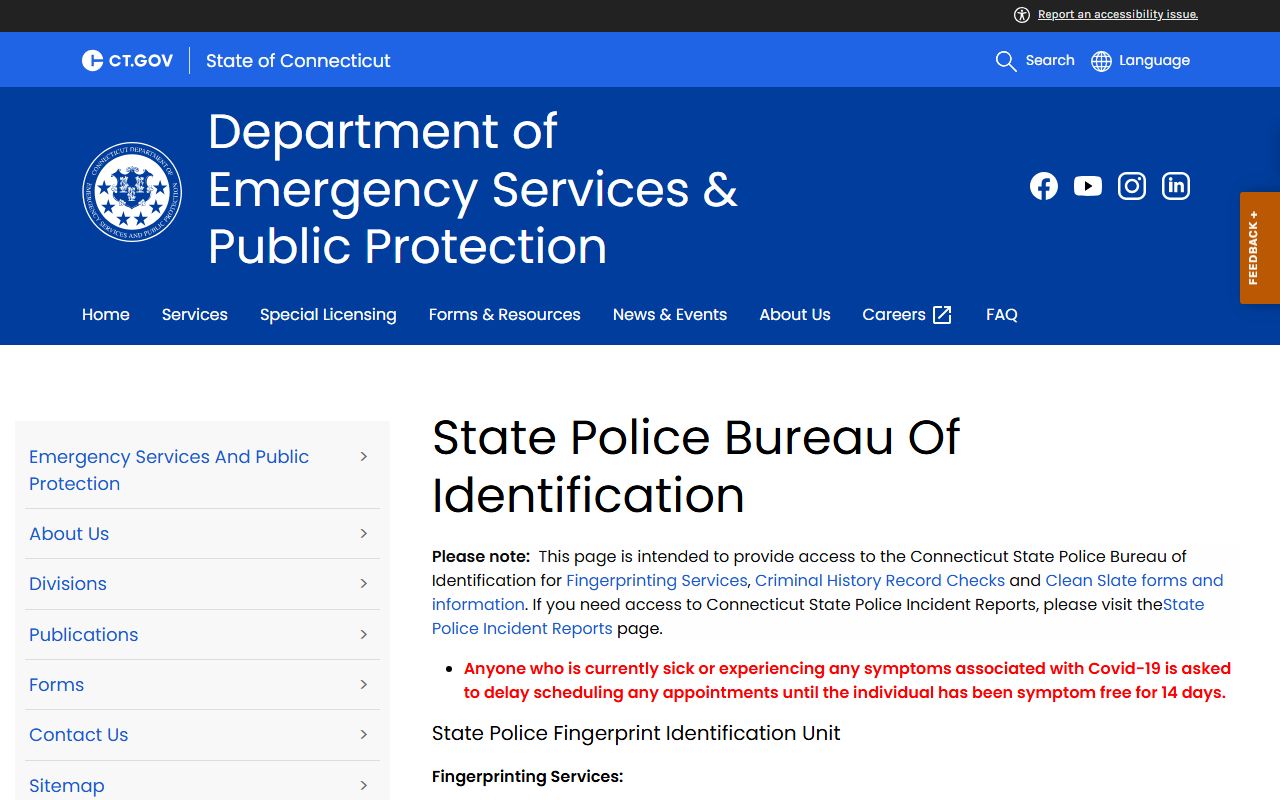
That page is the right starting point for an official conviction record tied to a Litchfield County arrest. It is separate from a booking photo, which still comes from the arresting agency under FOIA.
Note: Because arrest reports stay with the arresting agency, asking a county office or the prosecutor for a booking photo will not work in Connecticut.
Arresting Agency vs DOC vs Court
Three systems hold three different pieces, and readers mix them up constantly. The arresting agency holds the arrest report and any booking image. CT DOC holds current custody and facility status. The Judicial Branch holds the court case, the charges, and the disposition. No single search returns all three.
This split changes how you frame any request. If you want the picture, you go to the police agency under FOIA. If you want to know where someone is held right now, you use the DOC locator. If you want to know what happened with the charges, you use the court lookup. Knowing the difference saves wasted requests sent to the wrong office.
| What You Want | Where to Look |
|---|---|
| Booking photo or arrest report | The arresting police agency, by FOIA request |
| Current custody and facility | CT DOC inmate information search |
| Charges and case outcome | Connecticut Judicial Branch case lookup |
| Official conviction history | State Police Bureau of Identification |
The line between a charge and a conviction matters most for the photo question. An arrest and a booking photo do not prove guilt. CT DOC stresses that people in custody may be awaiting trial, not convicted. The court record on the court records after a Litchfield County arrest page is where charges turn into a clear outcome.
Erasure and Mugshot Removal Limits
Removal of a booking photo is not a simple delete request, and no website can be trusted to make a record vanish. Connecticut handles this through criminal-record erasure. The erasure statutes sit in Chapter 961a of the General Statutes. When a charge is dismissed, ends in acquittal, is nolled past the statutory waiting period, or is pardoned, the related records may qualify for erasure under the law.
Connecticut also runs an automated erasure process. It directs state agencies, including CT DOC and the Judicial Branch, to cooperate in clearing eligible records. This is the lawful path for getting an official record sealed or erased, and it works through the courts and agencies rather than a private vendor.
Two cautions belong here. No promise can be made that any third-party site will remove an image, and none should be believed. Police or DOC will not simply delete a photo on request outside the erasure framework. To pursue erasure, the request goes to the originating agency or the court, often with help from legal counsel.
What is and isn't public. Connecticut FOIA can open certain arrest and custody records, and the CT DOC locator shows where a person is held. It does not guarantee that a booking photo is online or that one will be released. Erased records, youthful-offender and juvenile cases, open investigations, and safety concerns are withheld, and erasure removes eligible records from public access entirely.
Federal and ICE Mugshot Limits
Federal and immigration custody work apart from any Connecticut channel. The Federal Bureau of Prisons inmate locator covers federal inmates from 1982 to the present. Its results give a name, register number, age, race, sex, release date, and location. They do not publish a booking photo in the locator interface.
Immigration custody uses a separate tool. The ICE Online Detainee Locator System finds people in immigration custody. It is a status locator, not a mugshot gallery. CT DOC says plainly that people held for federal immigration authorities are not in the DOC database, and it routes immigration-detainer questions to a regional office.
None of these federal systems offers public booking photos. So the only realistic photo route in a Litchfield County matter remains a FOIA request to the state or local agency that made the arrest.
Avoiding Commercial Mugshot Sites
Private mugshot-publishing sites are common online, and they are easy to mistake for official records. They are not government sources. Many copy old booking images, keep them up after charges end, and then ask for payment to take them down. Relying on them carries real risks for accuracy and for the people pictured.
Stick to the official channels instead. CT DOC confirms current custody. The arresting agency holds the booking record under FOIA. The Judicial Branch shows what happened with the charges. The State Police Bureau of Identification issues official criminal-history records. Each of these follows Connecticut law on accuracy and on erasure, which private sites do not.
One practical reason to favor official sources is correction. A record that has been erased under Connecticut law should drop out of the official systems. A commercial site has no such duty, so its copy may stay wrong for years. For status, charges, and lawful records, the government channels are both free or modestly priced and far more reliable.
Note: A pending charge is only an accusation, so a booking photo never establishes guilt and should not be treated as proof of a conviction.