
The Litchfield County Inmate Population
Connecticut does not run county jails the way most states do. In 1968, the state folded every county jail and state prison into one agency. The Connecticut Department of Correction has handled custody ever since. So there is no Litchfield County sheriff jail, no county roster, and no county booking gallery. People held after a Litchfield County arrest sit in a state facility and show up in state records.
Because custody is statewide, the Litchfield County inmate population is really a slice of the wider CT DOC count. The facility most tied to the county is New Haven Correctional Center. CT DOC says it serves the Bantam and Litchfield superior courts. It is a pretrial center, meaning it mostly holds people who are still awaiting trial. The June 2, 2026 facility count there was 501, based on the CT Open Data facility dataset. Statewide, the system held 10,763 people the same day.
The lead-in image below opens the agency that owns these records. CT DOC's home page lays out the unified system and links the public inmate search.
The CT DOC home page is the front door to facility lists, the inmate locator, and visiting rules.
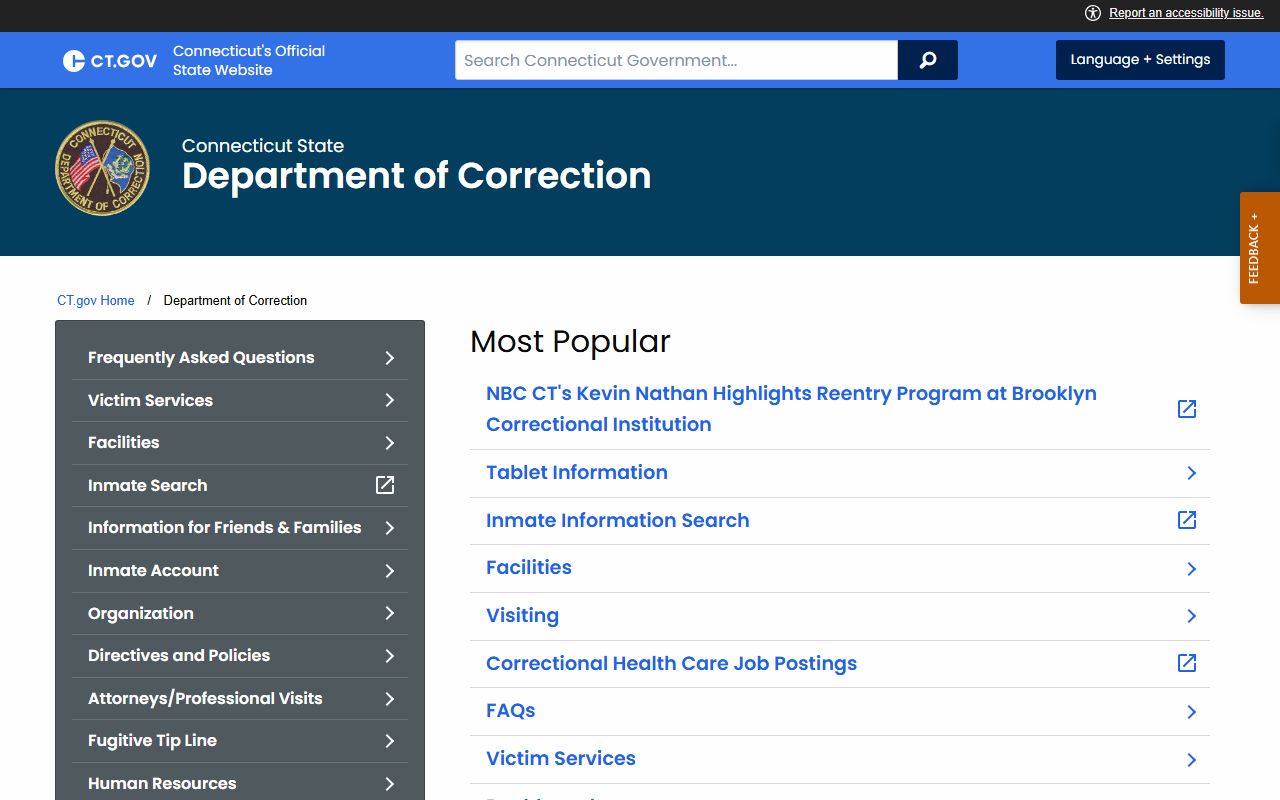
From that page, a searcher reaches the same locator that covers the Litchfield County inmate population and the rest of the state. Note: Connecticut still uses county names for geography, but custody records are kept by the state, not by a county office.
Litchfield County Inmate Population Statistics
The clearest numbers come from the Connecticut Open Data facility dataset. It posts a daily count for each correctional center, split into accused and sentenced status. For the facility serving Litchfield and Bantam courts, the June 2, 2026 total was 501. Of those, 400 were on accused status and 101 were sentenced. The facility also lists 275 present staff on its official page. These are sourced figures, not estimates.
The table below sets the key counts next to their source and date. The 660 figure is a population basis from a 2023 audit, not a rated cell capacity, so it is labeled that way. There is no county jail capacity to report, because no active county jail exists.
| Measure | Figure | Source / Date |
|---|---|---|
| New Haven CC total population | 501 | CT Open Data facility count, June 2, 2026 |
| New Haven CC accused status | 400 | CT Open Data facility count, June 2, 2026 |
| New Haven CC sentenced status | 101 | CT Open Data facility count, June 2, 2026 |
| Statewide DOC population | 10,763 | CT Open Data total count, June 2, 2026 |
| New Haven CC present staff | 275 | CT DOC facility page, June 2, 2026 |
| New Haven CC PREA population basis | 660 | 2023 New Haven CC PREA audit |
The dataset that drives these counts is open to the public. The CT Open Data facility daily population dataset posts each facility's count by day and legal status.
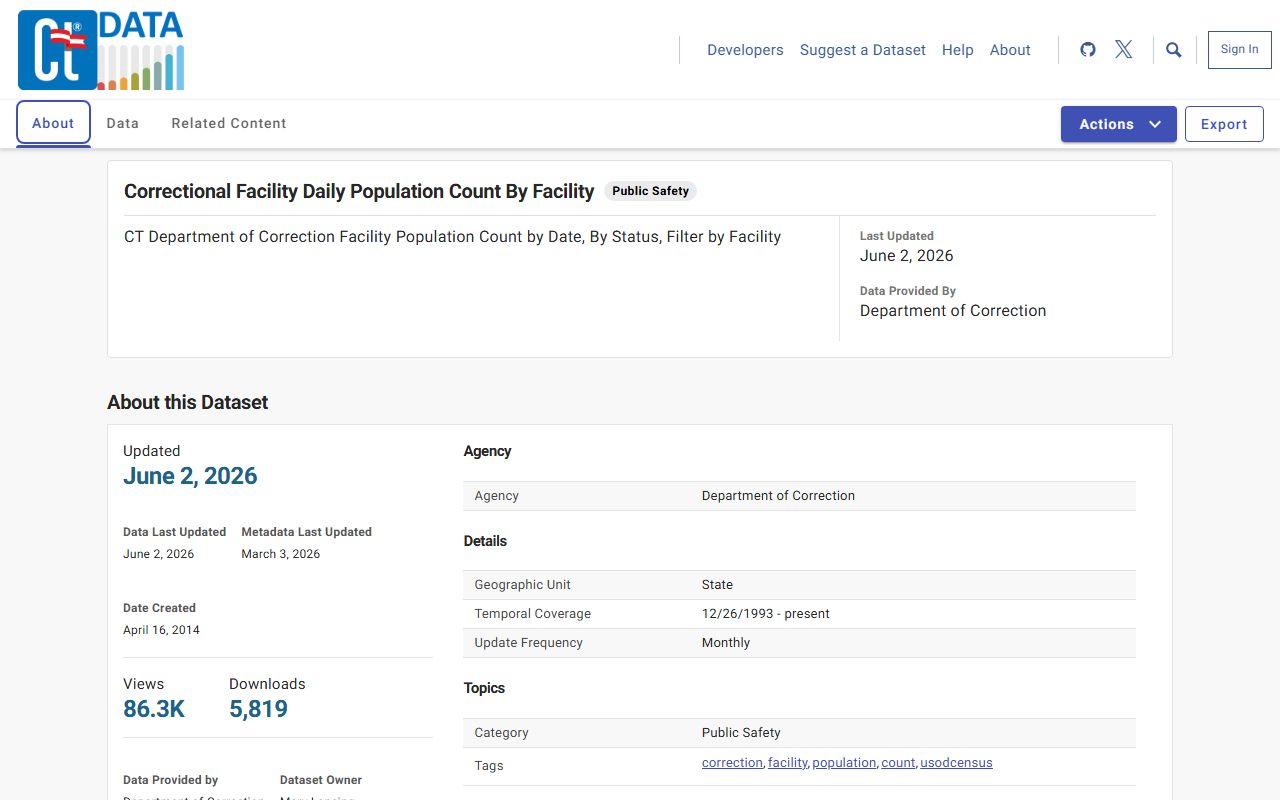
Anyone can pull the same daily count shown here and read the Litchfield-related figures for themselves.
Litchfield County Inmate Population Trends
Day-to-day movement is small at the facility level. Across late May and early June 2026, the New Haven CC count stayed close to 500. Accused status held near 400 the whole stretch. Sentenced status moved by only a few people. That pattern fits a pretrial center, where intake and release churn faster than long sentences do.
| Date | Accused | Sentenced | Total |
|---|---|---|---|
| June 2, 2026 | 400 | 101 | 501 |
| June 1, 2026 | 400 | 96 | 496 |
| May 31, 2026 | 399 | 96 | 495 |
| May 30, 2026 | 398 | 96 | 494 |
| May 29, 2026 | 398 | 97 | 495 |
| May 28, 2026 | 402 | 101 | 503 |
The statewide picture is steady too, with a slight downward tilt. CT Open Data put the total DOC population at 10,763 on June 2, 2026, down from 10,772 on May 28. The state's forecasters back this up. The OPM CJPPD population forecast reported a March 1, 2026 count of 10,944 and a March 2027 rolling estimate of 10,886, a change of about half a percent. So the broader pool that feeds the Litchfield County inmate population is flat to slightly falling.
CT DOC also publishes formal reports each month. The CT DOC monthly statistics index holds those population releases.
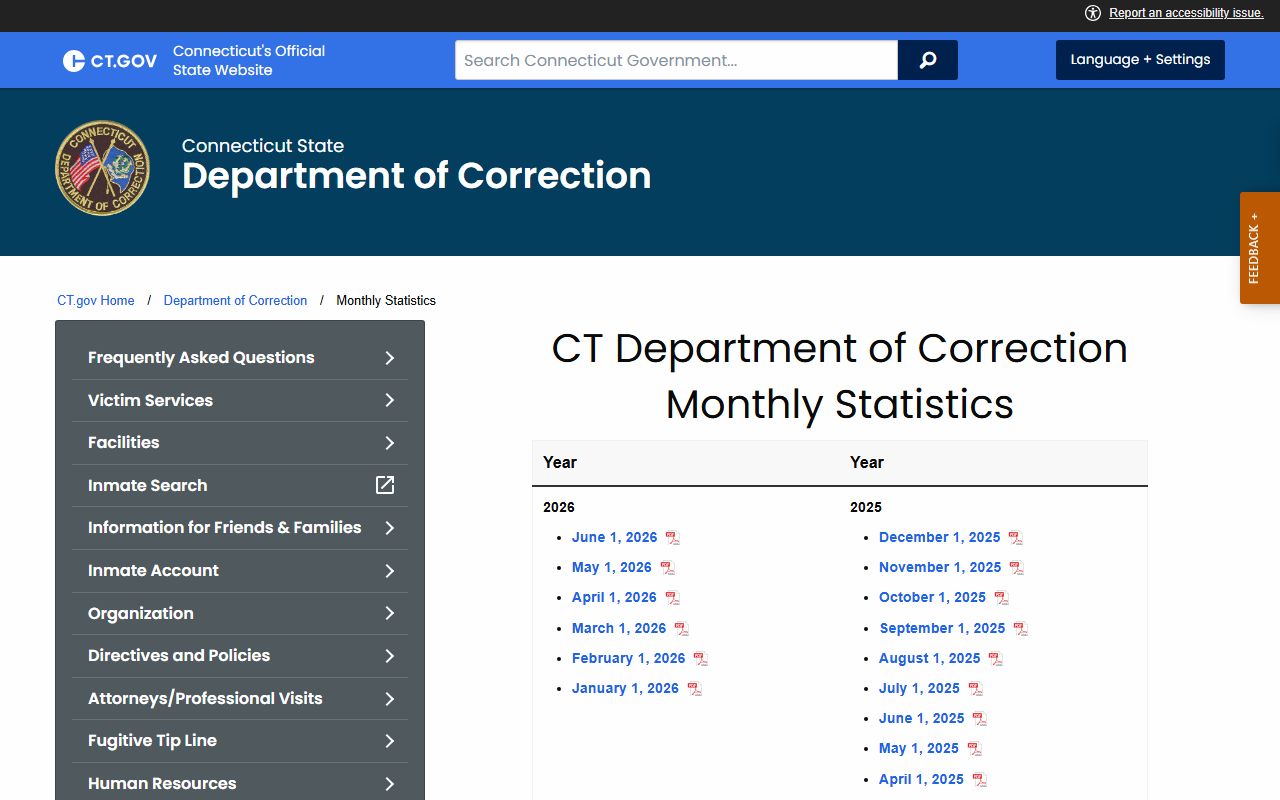
Those monthly files let a reader trace longer trends than the daily snapshots above show. Note: daily counts swing with bookings and releases, so a single day is not a trend on its own.
Who Makes Up the Litchfield County Inmate Population
The split that matters most in Connecticut is accused versus sentenced. Accused status means a person is held while their case is still open. They have not been convicted. Sentenced status means a court has already imposed a sentence. At the facility serving Litchfield courts, accused status is the large majority. That is why current incarceration there does not equal guilt.
Official sources do not publish a race, age, or sex breakdown at the facility level. The Open Data dataset reports legal status only. A 2023 PREA audit result described the New Haven CC population as male, ages 18 to 72, security levels 1 through 4, and no youthful inmates. Two groups are left out of the state inmate database entirely. People held under the Youthful Offender Statute do not appear. People held for Immigration and Customs Enforcement do not appear either.
- Accused status made up 400 of 501 at New Haven CC on June 2, 2026, per CT Open Data.
- Sentenced status made up 101 of 501 the same day, per CT Open Data.
- Sex and age ran male, ages 18 to 72, per the 2023 PREA audit result.
- Excluded groups are youthful offenders and ICE detainees, per the CT DOC inmate information page.
Litchfield Custody Capacity and Crowding
There is no county jail capacity to report for Litchfield County, because the county runs no jail. The figure closest to a capacity for the serving facility is the 660 population basis from the 2023 PREA audit result. That is not a strict rated bed count. The official facility page does not list a single rated-capacity line.
Measured against that 660 basis, the June 2, 2026 count of 501 sits well below it. So the facility was not over its reported population basis on that date. No active overcrowding lawsuit, consent decree, or county jail construction project applies here, because no county jail is in operation. Unofficial capacity numbers should be avoided, since the state does not publish a clean rated figure for this center.
Laws Behind Litchfield County Inmate Records
Public access to inmate and arrest records in Connecticut rests on the Freedom of Information Act and the state's erasure laws. The FOIA makes most public-agency records open unless an exemption applies. Arrest and custody records carry their own rule inside the law. Erasure statutes can later seal or wipe records when a case ends in the person's favor. These laws shape what stays visible in the Litchfield County inmate population and what comes down.
The plain-English meaning of each main statute appears below. Erasure means a record is treated as erased by law after a qualifying outcome. A nolle is a prosecutor's decision to drop a charge, which can later trigger erasure.
Key Connecticut Statutes:
Conn. Gen. Stat. Sec. 1-210 makes public-agency records open for inspection unless a statute or exemption blocks release.
Conn. Gen. Stat. Sec. 1-212 sets the rules and fees for getting copies of public records.
Conn. Gen. Stat. Sec. 54-142a erases eligible records after dismissals, acquittals, nolles, and pardons.
Conn. Gen. Stat. Sec. 54-142t sets up automated erasure and requires DOC and courts to cooperate.
Conn. Gen. Stat. Sec. 54-142e requires data sellers to update or delete records that have been erased.
Note: FOIA supports access to nonexempt records, but youthful-offender, juvenile, victim, safety, and erasure rules can still keep certain records private.
Litchfield County and the State Prison Count
When a Litchfield County case ends in a sentence, the person stays inside the same state system. They do not move to a county prison, because none exists here. Classification staff may shift a sentenced person from the New Haven center to any of the dozens of CT DOC facilities statewide. The choice depends on security level, health needs, gender, and program needs.
This is the key idea for searching. Litchfield County is the arrest and court geography. CT DOC is the custody geography. On June 2, 2026, the statewide system held 10,763 people, with 7,342 sentenced and 3,421 on accused or other status, per CT Open Data. A sentenced Litchfield defendant becomes one of those statewide figures. The facility name in the locator matters more than the county of arrest, so always read where the person is actually held.
How to Search the Litchfield County Inmate Population
The search starts at the state level, not a county page. The CT DOC Inmate Information Search is the official locator. It covers people held on accused status and on sentenced status across Connecticut. The public explainer page from CT DOC inmate information describes the daily update schedule and the accused-status caveat.
Have a few things ready before you search. A full legal name helps. A date of birth narrows common names. A CT DOC number is the strongest identifier if you have it.
- Open the CT DOC inmate locator. Do not look for a Litchfield County jail page, because there is none.
- Search by CT DOC number when you have it, since CT.gov lists it as a search path.
- If you lack a number, search by name and add a date of birth to filter results.
- Read the listed facility. For Litchfield or Bantam court arrests, New Haven CC is a likely pretrial location, but the person may be elsewhere.
- If a new arrest does not appear yet, call the CT DOC Public Information Office at (860) 692-7780 with the full name and date of birth.
- For sentenced federal custody, use the BOP locator. For immigration custody, use ICE. For alerts, use VINELink.
The search page itself is shown below. The CT DOC inmate search is where every Litchfield County custody lookup begins.
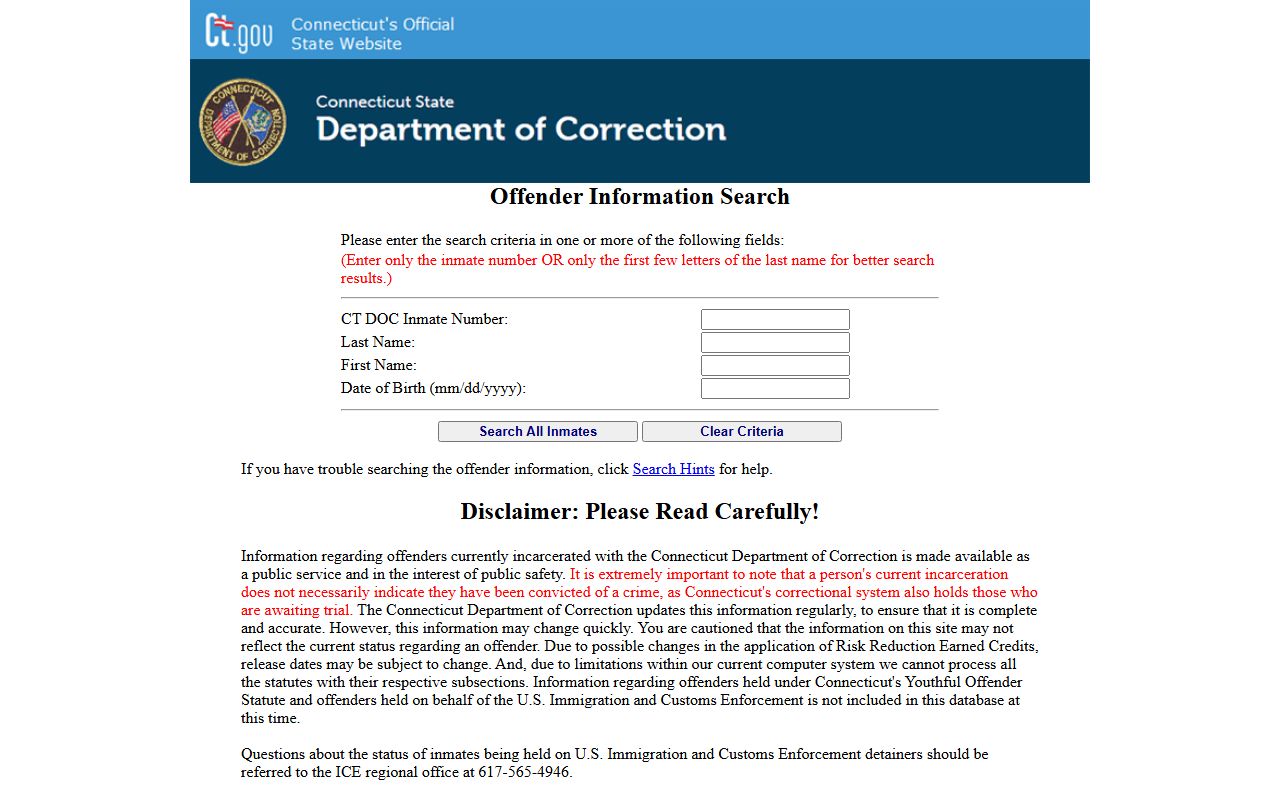
The same locator returns current facility and status for anyone held in the state system, including those tied to Litchfield courts.
Current Inmate Lookup in Litchfield County
The CT DOC locator is the live source for current custody. CT DOC says it updates the data daily. It also warns that status can change fast and that the site may not reflect the most current state. That matters for fresh arrests, which can take time to appear. The search fields are limited, but they are enough to find most people.
| Field Label | Type | Required | Notes |
|---|---|---|---|
| CT DOC number | Text | No | Best identifier when known; listed by CT.gov as a search path. |
| Name | Text | No | Use legal name; try spelling variants for common names. |
| Date of birth | Date | No | Narrows identity when the name is common. |
| Search / Submit | Button | N/A | Exact label not confirmed; portal blocked automated inspection. |
If the locator does not show someone you expect to find, do not assume the person is free. The record may be excluded, the arrest may be too recent, or the person may be in federal or immigration custody instead. A phone call to the Public Information Office is the next step for a confirmed status. Note: a person on accused status appears in the locator, yet that listing is not a conviction.
Past and Released Inmate Records
The state locator is built for current custody, not for a released-inmate archive. Once a person is released, they generally drop off the live search. There is no county booking history page to fall back on, because no county jail roster exists in Litchfield County. So tracing a past inmate means moving to other official channels.
Court records are the strongest trail for a closed case. The Connecticut Judicial Branch posts pending cases and conviction records by defendant. Criminal-history checks run through the State Police Bureau of Identification. Both can show outcomes long after release. Erasure can change or remove records, though. Under Connecticut erasure law, a dismissal, acquittal, or qualifying nolle can wipe a record, so an old case may no longer appear. The jail inmate records guide covers the records-request route in more detail.
Inside a Litchfield County Custody Record
Direct inspection of a CT DOC inmate profile was blocked during research, so the exact profile layout is not confirmed here. What the agency does state publicly is solid. The fields below reflect concepts the official sources support rather than a guessed screen layout.
| Field / Concept | What It Shows |
|---|---|
| Custody status | Whether the person is currently held under DOC supervision; can change quickly. |
| Legal status | Accused or sentenced; accused status is not a conviction. |
| Facility location | The current DOC facility, which the locator is meant to identify. |
| Update frequency | Information is updated daily, per CT DOC. |
| Exclusions | Youthful-offender and ICE-held people are not in the database. |
| Further requests | Routed to the DOC Public Information Office by phone or mail. |
For court-filed charges and case status, the Judicial Branch record is the right tool, not the custody locator. Booking charges and the charges a prosecutor finally files can differ.
Accused, Sentenced, Federal, and ICE Custody
Readers mix these systems up constantly, so it helps to lay them side by side. Connecticut has no county jail tier here. Instead, the divide is accused versus sentenced inside CT DOC, then a separate federal track and a separate immigration track. Each has its own locator and its own slice of the wider inmate population.
| CT DOC (Accused) | CT DOC (Sentenced) | Federal / ICE | |
|---|---|---|---|
| Who Is Held | Awaiting trial, not convicted | Sentence already imposed | Federal or immigration custody |
| Run By | Connecticut Department of Correction | Connecticut Department of Correction | BOP or ICE |
| Where to Look | CT DOC inmate search | CT DOC inmate search | BOP locator or ICE ODLS |
| In the State Database | Yes | Yes | No; ICE holds are excluded |
Note: a person can move from accused to sentenced status during a case, which may also move them to a different DOC facility statewide.
State, Federal, and Immigration Searches
The CT DOC locator handles state custody, both accused and sentenced. Federal and immigration custody sit outside it. The Federal Bureau of Prisons locator covers federal inmates from 1982 to the present. It searches by register number or by name with sex, race, and age filters. Release dates can shift under First Step Act credits, so the BOP advises checking back.
Immigration custody uses a different tool. The ICE Online Detainee Locator System is the official search for people in immigration custody. CT DOC states plainly that people held for ICE are not in its database, and it points ICE-detainer questions to a regional office. For ongoing alerts on a Connecticut inmate's status, VINELink Connecticut sends custody-change notifications. None of these tools is a mugshot gallery; each one reports custody and status only.
Litchfield County Detention Facilities
There is one facility to name for this county, and it is not inside Litchfield County. CT DOC designates New Haven Correctional Center as the center serving the Bantam and Litchfield superior courts. It is state-run, not county-run, and it holds mostly pretrial people. The historic Litchfield State Jail ran from 1812 to 1993 and is closed, so it is local history, not a lookup point.
- New Haven Correctional Center holds mainly pretrial inmates and serves the Bantam and Litchfield courts under CT DOC.
Sentenced inmates may later be classified to other CT DOC facilities across the state. The locator always shows the true current facility, which is why the state search beats guessing by county.
Litchfield Inmate Search Terms
A few corrections terms appear throughout any inmate lookup. Short plain meanings make the records easier to read.
- Accused status
- A person held while a case is open, before any conviction.
- Sentenced status
- A person held after a court has imposed a sentence.
- Detainer
- A hold placed by another agency or court that can block release.
- Nolle
- A prosecutor's decision to drop a charge, which may later trigger erasure.
- Erasure
- A Connecticut process that treats a qualifying record as erased by law.
- Classification
- The DOC process that assigns facility, security level, and programs.
Litchfield County Inmate Population FAQ
How big is the Litchfield County inmate population?
There is no separate county count, because Connecticut runs one statewide system. The facility serving Litchfield and Bantam courts, New Haven Correctional Center, held 501 people on June 2, 2026, per CT Open Data. That figure was 400 on accused status and 101 sentenced. Statewide, CT DOC held 10,763 people the same day. A sentenced Litchfield defendant becomes part of that statewide total once classified.
Is there a Litchfield County jail roster?
No. Connecticut unified its county jails and state prisons under one department in 1968. There is no Litchfield County sheriff jail, no county roster, and no county mugshot page. Anyone held after a Litchfield County arrest is tracked through the CT DOC inmate search instead. That single statewide locator is the right place to look for both accused and sentenced people.
How do I search the Litchfield County inmate population?
Start at the CT DOC Inmate Information Search. Search by CT DOC number if you have one. If not, use the person's legal name and add a date of birth to narrow the results. Read the listed facility carefully, since the person may not be at the New Haven center. If a recent arrest is not showing, call the DOC Public Information Office during business hours.
Why is the facility in New Haven, not Litchfield?
CT DOC assigns New Haven Correctional Center to serve the Bantam and Litchfield superior courts, plus Meriden, New Haven, and Waterbury. Litchfield County has no active state prison or county jail of its own. So a search tied to a Litchfield arrest often points to New Haven. The court geography and the custody geography are simply different in Connecticut.
Can I look up a released or past inmate?
The live locator is built for current custody, so released people generally drop off it. For closed cases, use the Connecticut Judicial Branch case search for pending matters and convictions. The State Police Bureau of Identification handles official criminal-history checks. Keep in mind that erasure law can remove eligible records, so an old case may no longer appear in any public search.
Does the inmate search show mugshots?
No official Litchfield County sheriff mugshot roster exists, since there is no county jail. The CT DOC locator is a custody and status tool, and direct inspection of its profiles was blocked during research, so it cannot be described as a mugshot source. Connecticut FOIA can support access to some arrest and custody records, but exemptions and erasure limit what is public. Federal and ICE locators publish no mugshots either.
What if the person is in federal or immigration custody?
Use a different locator. The federal Bureau of Prisons locator covers federal inmates from 1982 onward. The ICE Online Detainee Locator System covers immigration custody. CT DOC states that people held for ICE are not in its database, so an empty state search does not rule out federal or immigration custody. Check the matching federal tool to confirm.