
Court Records After a Jail Arrest in Litchfield County
After a Litchfield County arrest, two record systems split apart. The Connecticut Department of Correction shows current custody for anyone held. The Connecticut Judicial Branch case lookup shows the court records, which means the charges, the case events, and the final outcome. The Division of Criminal Justice prosecutes the case and decides how each charge proceeds. These are not the same office. A person can sit in custody while the court record changes, and the court record can outlive any time spent in a cell.
The starting point matters. Police write the first charges at the time of the arrest. A prosecutor then reviews those charges before court. That review can change what shows up in the court records, so the booking charge is not always the charge a court finally hears. For where someone is held and the booking side of an arrest, the jail inmate records page covers custody lookups and the booking process. Booking photos are addressed on the jail mugshots page. The court record itself takes over from that point.
Connecticut uses State's Attorneys, not district attorneys. The State's Attorney is the chief prosecutor for the judicial district. That office, the courts, and the corrections department each hold a different slice of what people call an arrest record.
The Litchfield State's Attorney and the Court Structure
The Litchfield Judicial District is led by State's Attorney David R. Shannon. The Criminal Justice Commission appointed him on March 21, 2022, and reappointed him effective July 1, 2025 for an eight-year term. He serves as the chief law enforcement officer for Litchfield and 23 surrounding towns, an area of about 140,000 residents. His office reviews charges, takes cases to court, and decides whether a charge moves forward, changes, or ends.
Court records after an arrest split by how serious the charge is. The Litchfield Judicial District office at Litchfield Superior Court, known as Part A, prosecutes the most serious cases, mostly class A and class B felonies. A felony is a crime that can bring more than a year of prison. The Geographical Area office at the Part B Superior Court in Torrington, called GA 18, handles class C, D, and E felonies, all misdemeanors, infractions, and motor-vehicle matters. A GA court, or geographical area court, is the local trial court for everyday criminal cases. Knowing which court holds the case tells you which court location to pick when you search.
The lead-in below opens the official prosecutor page. The Litchfield Judicial District State's Attorney page lists the office, its leadership, and the towns it covers.
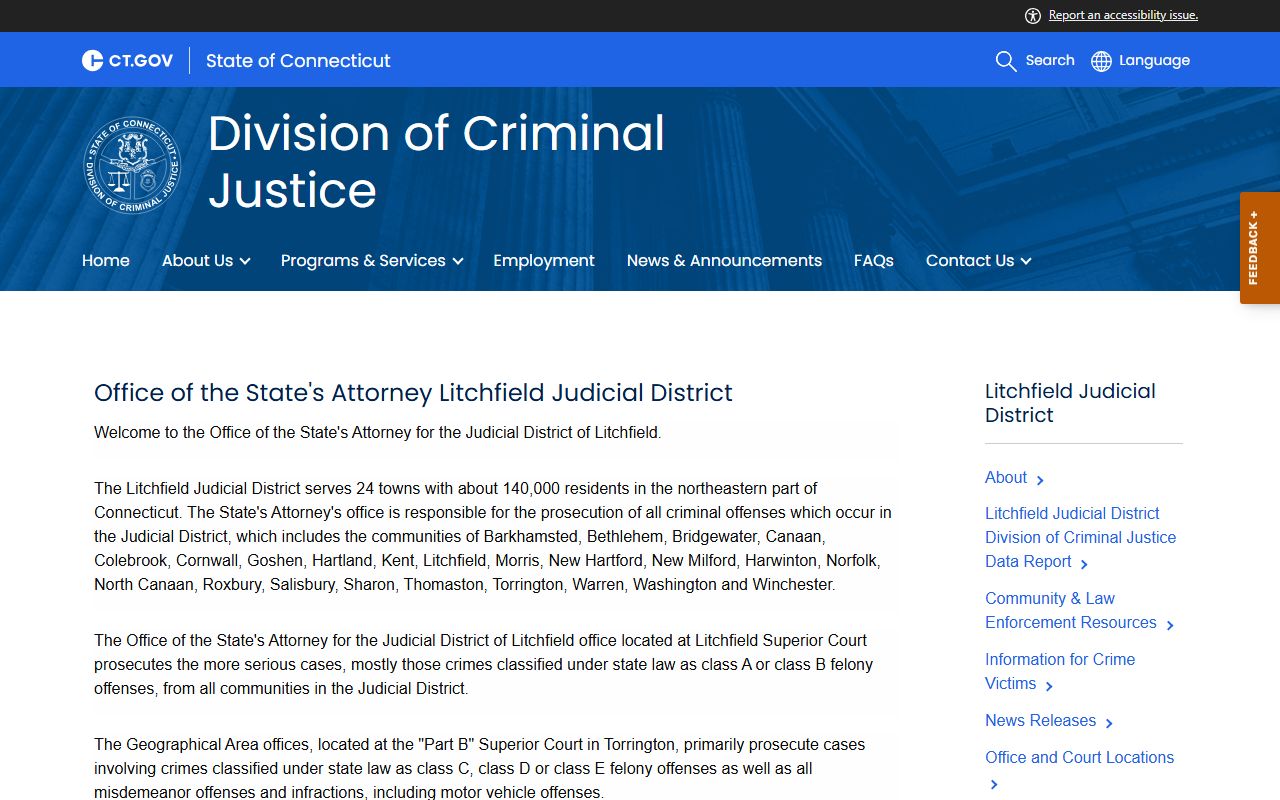
That page confirms how charges are routed and where the prosecution sits. Use it to learn which office is handling a given Litchfield County court case.
| Litchfield Part A | Torrington GA 18 / Part B | |
|---|---|---|
| Court | Litchfield Judicial District Superior Court | Part B Superior Court, Torrington |
| Handles | Class A and B felonies, the most serious cases | Class C, D, E felonies, misdemeanors, infractions, motor vehicle |
| Search location label | Litchfield Judicial District | Torrington GA 18 |
Note: A case can begin in the GA court and move to Part A if the charges turn out to be serious felonies under State's Attorney review.
How to Find Litchfield County Court Records After an Arrest
The Connecticut Judicial Branch runs the public case lookup. It splits into two searches. One covers pending cases that are still open. The other covers convictions that have closed. Both are free. The pending search is the right tool soon after an arrest, while the case is still moving through court.
The lead-in here opens the main lookup hub. The Judicial Branch criminal and motor-vehicle case lookup landing page links both the pending and conviction searches.
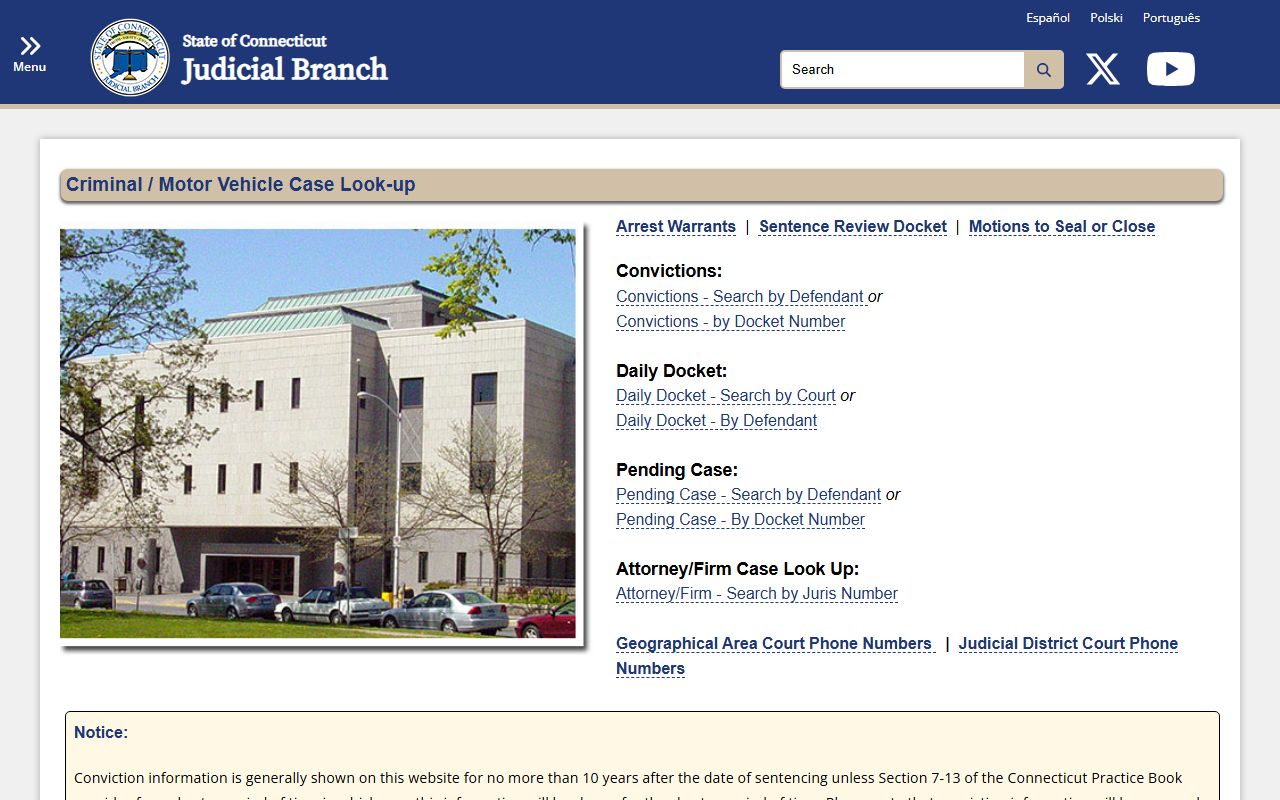
From there you choose pending cases or convictions, then enter the defendant name. Here is how to run a search after a Litchfield County arrest.
- Open the Judicial Branch case lookup landing page and pick the pending cases search or the convictions search.
- Type the defendant last name. The form searches by the start of the last name, so a few letters can work.
- Add a first initial and a birth year to narrow a common name. The birth-year range can be widened if needed.
- Pick a court location if you know it. Choose Litchfield Judicial District for serious felonies or Torrington GA 18 for most other charges.
- Open the matching case and read the charge list, the charge level, the next court date, and the current status of each count.
The pending cases search by defendant lives at the Connecticut pending criminal cases search. It is the fastest way to see a case that opened after a recent arrest. Custody and arrest detail still sit on the jail side, so the case lookup answers the court question, not the cell-location question.
Searching Litchfield County Conviction Records
Once a case ends, it moves out of the pending search and into the convictions search. The convictions tool reports cases that closed with a finding or plea of guilt. It is a separate page from the pending search, and the field set is slightly different. The court location list includes Litchfield Judicial District, Torrington GA 18, Waterbury, New Haven, and many other locations across the state.
The lead-in opens the form itself. The convictions search by defendant asks for a last name and lets you narrow by initial, birth year, court, and category.
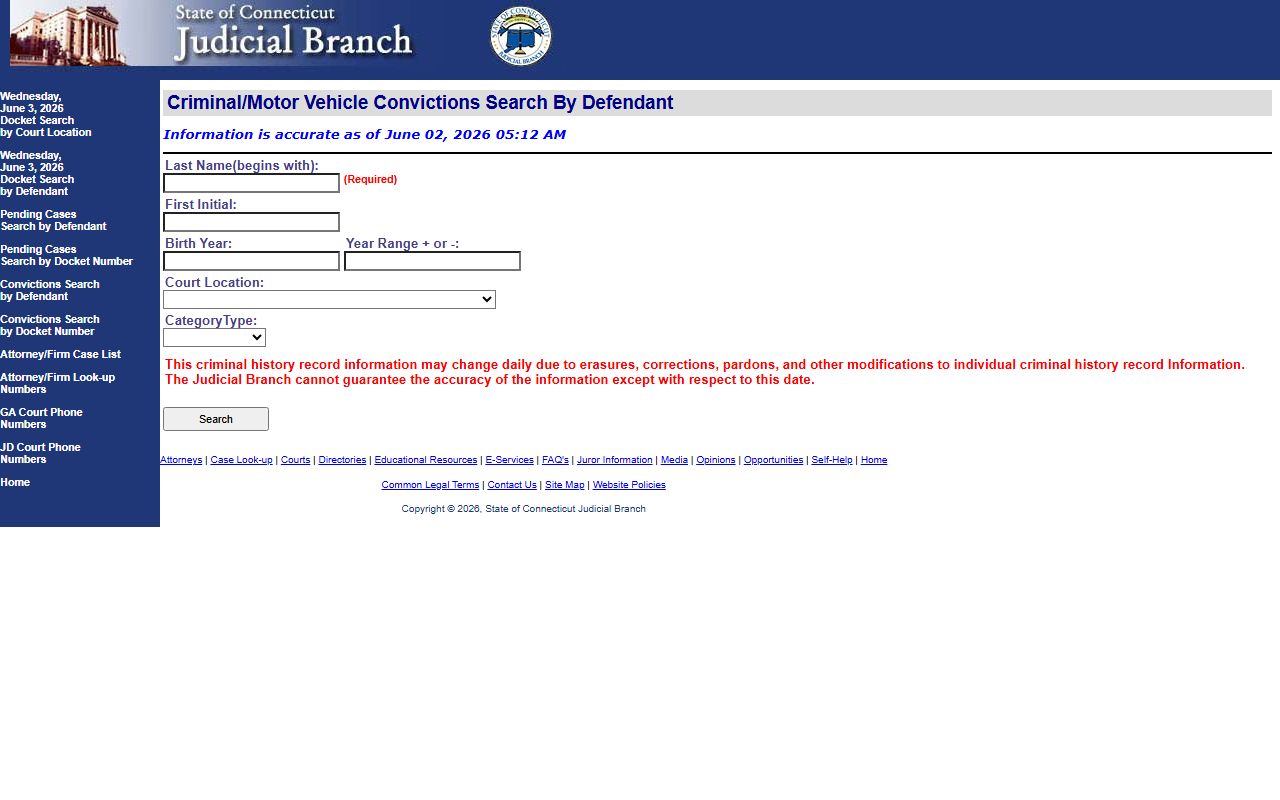
The follow-up below lists the exact fields the convictions form uses, as inspected on June 2, 2026.
| Field | Type | Required | Notes |
|---|---|---|---|
| Last Name (begins with) | Text | Required | Searches the start of the last name. |
| First Initial | Text | Optional | Narrows common last names. |
| Birth Year | Text | Optional | Use the year only. |
| Year Range + or - | Text | Optional | Broadens the birth-year match. |
| Court Location | Dropdown | Optional | Includes Litchfield Judicial District and Torrington GA 18. |
| Category Type | Radio | Optional | Criminal or Motor Vehicle. |
The Judicial Branch warns that this data can shift. On June 2, 2026 the page reported its information as accurate as of 5:12 AM. It cautions that criminal-history record data may change daily because of erasures, corrections, pardons, and other updates, and that accuracy is only guaranteed for the displayed date. Read every result as a snapshot, not a final answer.
How Charges Get Filed After an Arrest
Connecticut has a clear charging path, and it does not run through a grand jury for ordinary cases. The arresting agency writes the first charges. A police department or a Connecticut State Police troop usually makes the arrest in a Litchfield County town. After that, the court receives the case and the prosecutor reviews the charges. The State's Attorney office handles serious Part A matters, while the Torrington GA office handles most lesser felonies, misdemeanors, infractions, and motor-vehicle charges.
From there, charges are not fixed. A prosecutor can amend, substitute, reduce, dismiss, or nolle a charge, and a case can end by plea or by trial. A nolle, short for nolle prosequi, is a prosecutor decision not to push a charge forward at that time. Because of this, the booking charge written at the arrest can differ from the charge the court finally records. The arrest paperwork is one document. The court record is the living account of what happened next.
- Police charges: the arresting agency lists the first counts at the time of the arrest.
- Prosecutor review: the State's Attorney or GA office checks the charges before court.
- Filing: Part A takes serious felonies; GA 18 takes most other criminal matters.
- Changes: counts can be amended, reduced, added, nolled, or dropped.
- Disposition: the case ends by plea, trial, dismissal, or other outcome.
Note: Roster or arrest charge wording is not the final court disposition, so always confirm the count in the Judicial Branch case record.
Charge Status and What It Means
A court record shows a status for each count. The status tells you where that charge sits right now. These terms come up often in Connecticut criminal cases, and each one means something specific. Reading them correctly keeps a reader from assuming an arrest equals a guilty result.
| Status | What It Means |
|---|---|
| Pending | The case is open and still moving through court. No final outcome yet. |
| Amended or Reduced | The prosecutor changed the count, often to a lesser charge. |
| Dismissed | The charge ended with no conviction. |
| Nolle Prosequi | The prosecutor chose not to proceed; the charge can be erased after a set period. |
| Disposed by Plea or Trial | The case closed by a guilty plea or a verdict. |
Status changes can lag behind a court date. A count marked pending in the morning may be updated later that day. When the record and a known court event do not match, the court clerk for the case location can confirm the current state.
Bond and Release After an Arrest
Bond is the money or set of conditions that secure a return to court. In Connecticut, release is tied to police action and the court, not to a county jail cashier window, because there is no county-run jail here. The release path depends on the charge, the person's record, and any holds. Lower-risk cases often release on a promise to appear. Serious cases, warrant holds, domestic-violence holds, and out-of-jurisdiction holds can keep a person in custody.
- Promise to appear / recognizance: release on a signed promise and conditions, common for lower-risk matters.
- Cash or financial bond: a money amount must be posted; the method depends on police, court, or DOC status.
- Surety bond: a licensed bail bond agent posts the bond; check the license and fees first.
- Court-ordered conditions: terms like no contact, a protective order, treatment, or appearance rules.
- Hold or detainer: another warrant, court order, or immigration issue that blocks release even if bond is paid.
To verify bond and the next court date after a Litchfield County arrest, search the Judicial Branch pending cases first. Then check Connecticut Department of Correction custody if the person is held. Calling the court clerk or the arresting agency helps for an immediate post-arrest release question before someone enters DOC custody. A detainer is a hold placed by another agency, and it can stop a release even after one bond is paid. Commercial inmate or bondsman pages should not be treated as the official source for custody or bond.
Warrants, Holds, and Failures to Appear
Many Litchfield County arrests start with a warrant. A warrant is a judge-authorized order. There is no Litchfield County sheriff active-warrant list, because the county has no active sheriff jail agency. Warrant questions route to the courts and the arresting agencies instead. Bench warrants and failure-to-appear warrants are court records and may show in the Judicial Branch case information, but online case lookup is not a complete warrant-clearance tool.
The arresting agency may be Connecticut State Police or a town department. State Police Troop A serves Roxbury; Troop B covers towns such as Canaan, Cornwall, Norfolk, Salisbury, and Sharon; Troop L covers Litchfield, Kent, Morris, and others. Thomaston, Torrington, Washington, and Winchester run municipal departments. The type of warrant shapes what happens next.
- Arrest warrant: a judge-authorized order based on probable cause.
- Bench warrant or failure to appear: issued for missing court or breaking a court order.
- Violation warrant: tied to probation, parole, or a protective order.
- Fugitive or out-of-state warrant: can lead to a hold while another state confirms its claim.
Note: Do not appear at court expecting a blanket warrant-clearing process; call the relevant court clerk or the arresting agency first to confirm how a warrant is handled.
Charges vs. Convictions in Court Records
Being arrested and charged is not the same as being convicted. A charge is an accusation. A conviction is a finding or plea of guilt. The Connecticut Department of Correction even warns that current incarceration does not mean a person is convicted, because the system also holds people on accused status while they await trial. Court records reflect that split, and so do the search tools, which keep pending cases apart from convictions.
| Charge | Conviction | |
|---|---|---|
| Stage | Accusation by the prosecutor | Guilty plea or verdict |
| Proof needed | Probable cause to arrest and charge | Proof beyond a reasonable doubt |
| Where it shows | Pending cases search | Convictions search |
| Can change | Yes, can be reduced, nolled, or dismissed | Final unless appealed or pardoned |
This difference is why a single name can have a pending count, a dismissed count, and a conviction across different cases. Reading each count's status, not just the headline charge, is the only accurate way to understand a court record.
Criminal-History Records Through State Police
The court case lookup shows one case at a time. An official statewide criminal-history check is a different record, and it comes from the State Police Bureau of Identification. The Division of Criminal Justice says it does not give out criminal records and points people to the State Police, the Judicial Branch, and the corrections department depending on the record type. The Bureau handles these checks by mail only and does not accept drop-off or pick-up for requests that need criminal-history records.
The State Police Bureau of Identification lists the request steps and the fees. The mailed form is DPS-0846-C. Fees run $36 for a Connecticut name and date-of-birth search that reports whether a record exists, and $75 for a Connecticut conviction-history record by name and date of birth when a record exists. A fingerprint-based conviction-history check is also $75, with an added $15 fingerprint fee if the prints are taken at a Connecticut State Police location.
Note: A formal background check for employment or housing falls under federal law and must run through an FCRA-compliant agency, not a casual public lookup.
Erasure of Court Records After an Arrest
Connecticut does not use the words sealing or expungement the way many states do. It uses erasure. Erasure is the legal process that makes an eligible criminal record erased under statute. The main rule is Conn. Gen. Stat. Sec. 54-142a, with an automated erasure process under Sec. 54-142t and an update duty for certain background-screening purchasers under Sec. 54-142e. A record can qualify for erasure after a dismissal, an acquittal, a nolle that ages past the statutory period, or a pardon, among other paths.
When a record is erased, the law treats it differently from a public case. This is also why the Judicial Branch warns that its data can change daily due to erasures and pardons. Removing a court record is not a request you make to a website, and the corrections department will not simply delete a photo on request. Erasure questions go to the originating court or agency, or to legal counsel.
Key Connecticut statutes for court records after an arrest: the Conn. Gen. Stat. Sec. 1-210 open-records rule makes public-agency records open unless an exemption applies; Conn. Gen. Stat. Sec. 1-212 sets the copy and fee framework and includes the law-enforcement rule that arrest or custody records during a pending prosecution must be disclosed unless exempt; and Conn. Gen. Stat. Sec. 54-142a governs erasure of eligible records.
Restricted Court Records in Litchfield County
Not every court record after an arrest is open to the public. Connecticut FOIA opens public-agency records as a rule, but several exemptions narrow that rule. Erased records are protected. Youthful-offender records and juvenile matters are shielded. Pending investigations, victim privacy, and safety concerns can also limit release. So can records that a court has restricted.
This is why a name that appears in a news arrest report may not show a public case, and why a dismissed charge may be withheld after erasure. The honest takeaway is simple. Court records cover most adult criminal cases after an arrest, but they are not a guarantee that every record is online or available. When a record is missing, the court clerk or the originating agency is the right place to confirm whether it exists and whether it can be released.